Key takeaways
- On a multi-building site the private mains between the master meter and the buildings are the association's, and usually have no as-built drawing.
- A master-meter loss is confirmed and quantified first, then the mains are traced and located acoustically with a correlator across the long runs.
- Emergency work means securing the common area, pumping, lighting for after-hours, and keeping residents informed.
- Expect a written report with photos for the board, the owner and the insurer.
The multi-family problem
A single-family leak is one line, one meter, one owner. A condominium or apartment complex has a master meter at the street, a private main running between buildings, branches into each building, irrigation mains across the common areas, and often decades of repairs nobody documented. The association pays the master bill, the manager isn't on site, and residents notice a flooded lawn or a pressure drop long before anyone looks at the meter. By the time it's a work order, water may have been running for months.
Confirming and quantifying
The investigation starts at the master meter with the buildings' consumption accounted for, ideally overnight when use is lowest. A continuous low-flow reading at 3 a.m. is a loss. Where the buildings can be isolated at their shutoffs, isolating them one at a time attributes the loss to the mains or to a particular building. Irrigation is isolated separately; it's the culprit on a surprising share of HOA investigations.
Tracing and locating
The private mains are traced with a pipe locator from the meter to each building and valve. Then acoustic detection with a correlator across the long runs narrows the break, and the ground microphone pinpoints it. For a manager that means one excavation in one place with a marked spot and a depth estimate, instead of a landscape contractor trenching the lawn between two buildings on a guess.
Emergencies around residents
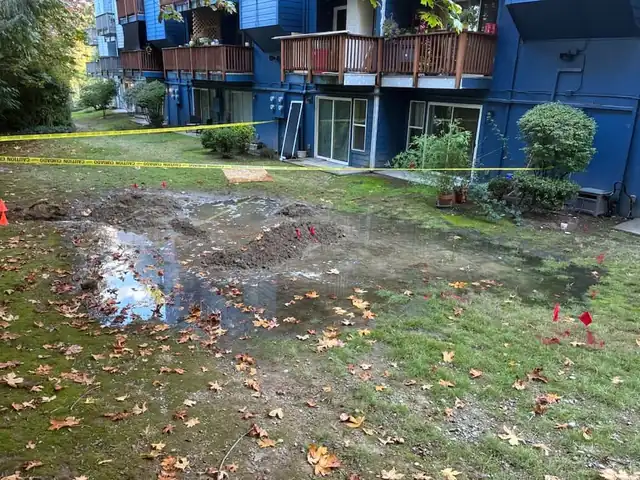
A main break at a complex is a safety issue before it's a plumbing issue. The area is taped off and coned, plywood goes down over soft ground and walkways, standing water is pumped away from buildings and walkways, and lights go up for night work. Residents get told what's happening and when water will be off and on. Our mini excavator and crew open the ground at the break, make the repair, restore water, and backfill and restore the common area. We've done this at Kitsap condo complexes at midnight and we're set up for it.
Documentation
Boards, owners and insurers need a record. Expect a written description of the investigation, what was found and where, what was done, and photos of the exposed line and the repair, along with a candid note on the condition of the rest of the main. That record supports a bill adjustment request to the utility, an insurance claim where coverage exists, and the reserve study conversation about replacing aging mains before the next break.
Scheduled investigations
For a property with a chronically high master bill and no obvious leak, a scheduled overnight investigation is a cheap way to find out what's going on before it becomes an emergency. We work with the property management companies and boards around the county on exactly that.
Written by the crew at 360 Leak Finders
We locate, excavate and repair buried water lines and exterior drains across Kitsap County, 24 hours a day. If this guide raised a question about your property, call (206) 354-9906.