Key takeaways
- Close every fixture, then watch the meter's low-flow indicator for two minutes. Movement means water is leaving the system.
- Close the house's main shutoff and watch again. Still moving means the buried service line; stopped means the house or irrigation.
- Timing the sweep hand or reading the digits over an hour gives you an actual gallons-per-hour number.
- Meter boxes in Kitsap are at the street or property line, often under a lid that needs a screwdriver or a meter key to lift.
Find the meter
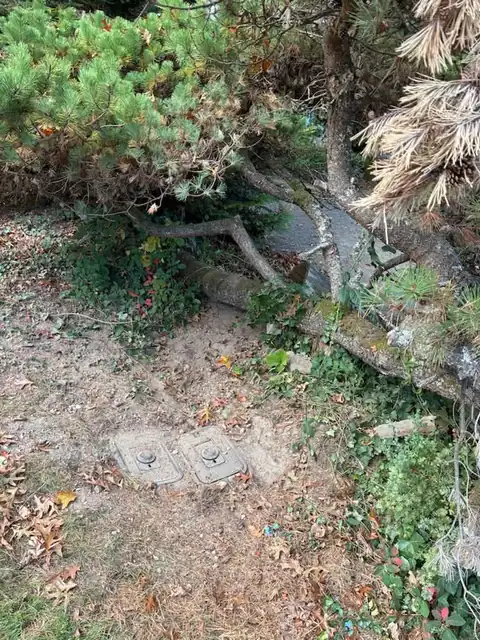
On a utility-served Kitsap property the meter is at the edge of the street or the property line, in a rectangular box with a metal or plastic lid, often marked WATER or with the utility's name. In older Bremerton, Port Orchard and Poulsbo neighborhoods it may be under a sidewalk repour or a hedge; on acreage in Kingston or Bainbridge it may be at the road a long way from the house. The lid usually lifts with a flat screwdriver or a meter key. Inside is the meter, sometimes under a hinged cap, and on many installs a shutoff valve on the utility side.
If you can't find the box, the utility can usually tell you where it is from their records, and a pipe locator will find the metallic box and the line.
Read the dial
Most residential meters have a digital or odometer-style register that counts total gallons or cubic feet, a sweep hand that makes one revolution per gallon or per cubic foot, and a low-flow indicator: a small triangle, star, gear or dial that turns with even a trickle of flow. The low-flow indicator is the leak detector. It will turn when the sweep hand appears motionless.
Newer meters in the county are increasingly electronic with a digital display that shows flow rate directly, and some show a leak icon when continuous flow has been detected over a period. If yours is electronic, the display will usually show a flow number; anything above zero with the house closed is your answer.
Test one: is water leaving the system?
Make sure nothing in the house is using water: no running toilets, no washing machine, no ice maker filling, no irrigation, no hose. Toilets are the usual culprit for a false result, so listen at each one. Then watch the low-flow indicator for two full minutes. If it moves at all, water is leaving the system somewhere.
Test two: is it the buried line or the house?
Close the house's main shutoff valve, which is usually where the service line enters the house: in the crawlspace, a utility room, a garage wall, or at a hose bib near the foundation. With that valve closed, the house and all of its plumbing is isolated from the service line. Watch the low-flow indicator again for two minutes.
If it keeps moving, the leak is between the meter and the shutoff: the buried service line. That is the leak an acoustic locate will find. If it stops, the leak is inside the house or on an irrigation branch that tees off after the shutoff. Toilets, water heaters, softeners and irrigation valves are the usual suspects.
Get a number
If you want to know how much water is leaking, note the register reading, wait an hour with everything closed, and read it again. The difference is gallons (or cubic feet; one cubic foot is about 7.48 gallons) per hour. Multiply by 24 for a daily number and by 30 for what it's doing to your bill. A number also helps the technician: a leak losing 50 gallons an hour sounds very different from one losing 5.
A note on irrigation
If the irrigation system tees off the service line before the house shutoff, which is common, test two will still show flow even if the house is fine. Isolate the irrigation at its own shutoff or backflow assembly and test again. A lot of surprise bills in Silverdale, Port Orchard and Bainbridge turn out to be irrigation mains.
Written by the crew at 360 Leak Finders
We locate, excavate and repair buried water lines and exterior drains across Kitsap County, 24 hours a day. If this guide raised a question about your property, call (206) 354-9906.