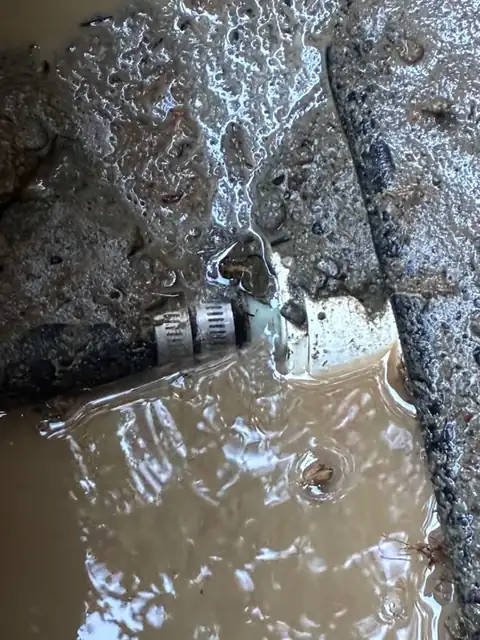
Key takeaways
- The most reliable sign is the water meter's low-flow indicator moving with every fixture in the house closed.
- In well-draining Kitsap soils a leak often produces no wet spot at all; the bill is the only sign.
- Where water does surface, it is frequently far from the actual break, following the pipe trench or a hardpan layer downhill.
- On a private well, the sign is a pump that cycles constantly or never shuts off.
Why buried leaks are easy to miss
A leak inside a house announces itself: a drip, a stain, a sound in the wall. A leak on the buried service line between the meter and the house has none of that. The pipe is two or three feet underground, the water goes into the soil, and in a lot of Kitsap County the soil either drains so well the water disappears or holds it so well it surfaces somewhere unexpected. Homeowners routinely live with an underground leak for months, and a surprising number only learn about it when the utility sends a notice about continuous usage.
The eight signs
- A water bill that is noticeably higher with no change in household use. Compare to the same month last year, not last month; summer irrigation and winter guests both move the number.
- The meter's low-flow indicator moving with every fixture closed. This is the single most reliable test and takes five minutes.
- A well pump that cycles constantly, runs without stopping, or a pressure tank that drains down with nothing running.
- A soft, spongy or unusually green patch of lawn, especially one that stays green through August when the rest of the yard browns.
- Water surfacing at a retaining wall, a bulkhead, the base of a slope or the edge of a driveway, with no rain to explain it.
- A drop in water pressure at the fixtures farthest from the meter, or pressure that falls when a second fixture opens.
- Damp soil or standing water in a crawlspace with no plumbing nearby, often on the side of the house facing the meter.
- A sinking spot or a heave in a gravel or paved driveway over the line's route.
The bill and the meter
The bill is where most Kitsap homeowners first notice. Utilities including the City of Bremerton, Silverdale Water District, Kitsap PUD and West Sound Utility District read meters on a regular cycle and some will flag continuous usage. A bill that is two or three times normal with no explanation almost always means water is leaving the system somewhere, and a quick meter test will tell you whether it's on the buried line. Our guide to reading your water meter for leaks walks through the test step by step.
Wet spots: where the water surfaces is not where the leak is
This is the most important thing to understand about underground leaks in Kitsap County. The peninsula's glacial till has a hardpan layer a foot or two down that water cannot easily penetrate. Water from a leak flows along that layer, or along the backfilled pipe trench which is looser than the surrounding ground, until it finds a low point or a slope and surfaces there. On a sloped lot in Port Orchard, Manchester or Bainbridge Island the water can show up fifty or a hundred feet downhill of the break. Digging at the wet spot is the most common and most expensive mistake homeowners and general contractors make. Acoustic locating finds the break itself.
Signs on a private well
Homes on wells in Olalla, Seabeck, Lofall, Hansville and much of Bainbridge get no water bill, so the signs are different. The pump cycles far more than it used to, or it runs continuously. The pressure tank, which should hold pressure for a long time with nothing running, drains down in minutes. Pressure at the far fixtures drops. The electric bill climbs. In a bad case the pump overheats and fails. Any of those on a well with a long buried line to the house is worth a locate before the pump gets replaced for no reason.
What to do if you see the signs
Do the meter test or the pressure tank test. If the loss is on the buried line, call a company that can locate acoustically and repair in-house, so the digging happens once in the right place. If the loss stops when the house is isolated, the problem is indoors or on irrigation and a plumber or irrigation contractor is the right call. If water is actively flooding, shut off the main and treat it as an emergency.
Written by the crew at 360 Leak Finders
We locate, excavate and repair buried water lines and exterior drains across Kitsap County, 24 hours a day. If this guide raised a question about your property, call (206) 354-9906.