Key takeaways
- Pressurized water escaping a buried pipe makes a continuous sound that travels through the pipe wall and the surrounding soil.
- An acoustic ground microphone listens for that sound from the surface; a leak noise correlator calculates the leak's position from the time difference between two sensors.
- Locating is done from the surface. Digging only happens at the marked spot, which is why it saves so much money compared to exploratory trenching.
- Soil type, pipe material, depth and background noise all change what the leak sounds like, and reading those differences is the technician's skill.
The sound a leak makes
A water service line is under pressure all the time, typically somewhere between 40 and 80 pounds per square inch on a Kitsap County system. When the pipe wall fails, water is forced out through the opening at high velocity into the surrounding soil. That creates turbulence at the break, and turbulence creates sound: a hiss, a rush, sometimes a rhythmic pulse if the leak is at a fitting that flexes. The sound travels along the pipe wall in both directions and radiates outward through the soil to the surface.
That sound is the whole basis of acoustic leak detection. It is continuous as long as the line is pressurized, it has a characteristic frequency range that depends on the pipe material and the size of the opening, and it is loudest directly over the break. The technician's job is to find the loudest, most consistent point along the pipe's route, and to tell that sound apart from traffic, wind, a nearby pump, a creek, or the hum of a refrigerator through a crawlspace wall.
Step one: prove there is a leak and that it's on the buried line
Before anyone listens for anything, the leak has to be confirmed and isolated. On a metered system that means closing every fixture in the house and watching the meter's low-flow indicator, the small triangle, star or dial that turns with even a trickle of flow. If it moves, water is leaving the system. Then the house is isolated at the main shutoff. If the indicator keeps moving with the house isolated, the loss is between the meter and the shutoff: the buried service line. If it stops, the loss is inside the house or on an irrigation branch, and acoustic locating on the service line would be a waste of everyone's time.
On a private well the same logic applies with gauges at the pressure tank. The buried line is isolated from the pump and tank on one side and the house on the other, and pressure is watched. A drop with everything isolated means the buried line is losing water.
Step two: trace the pipe's route
You cannot listen along a pipe if you don't know where it runs, and on most Kitsap properties nobody does. The line may go straight from the meter to the house, or it may detour around an old septic tank, cross a neighbor's lot on an easement, or enter the house somewhere other than where the plumbing suggests. A pipe and cable locator traces metallic pipe and tracer wire directly by inducing a signal onto the line and following it. Plastic pipe without tracer wire is harder: the technician uses acoustic methods, a sonde pushed through accessible pipe, and reasoning from fixed points like the meter, shutoffs and the point of entry. The traced route is marked on the ground.
Step three: the ground microphone
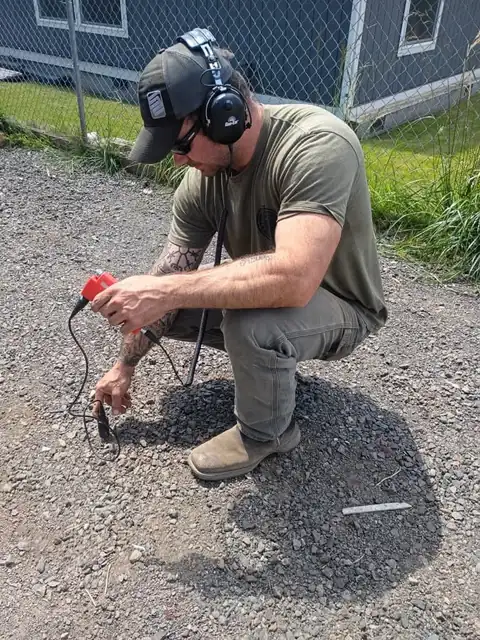
The acoustic ground microphone is a sensitive sensor on a handle or a plate, connected to an amplifier and headphones, with filters that let the technician narrow the frequency range to the band where leak noise lives. The technician walks the traced route, placing the sensor on the ground every few feet and listening. As the sensor approaches the break the leak noise gets louder and more consistent; past the break it fades. The technician works back and forth to find the peak.
Soil matters here. Dense till and clay transmit sound reasonably well but also carry it along the pipe trench, so the peak can be broad. Loose outwash sand and gravel absorb sound, which makes a small leak hard to hear at the surface. Depth matters too: a line three feet down is quieter at the surface than one eighteen inches down. The technician adjusts filters and technique for the ground, which is why experience in local soils counts.
Step four: the leak noise correlator
On a long run, walking the whole line with a ground microphone is slow and the peak can be ambiguous. A leak noise correlator solves that. Two sensors are attached to the pipe at accessible points, typically the meter and the house shutoff, with the distance between them measured. The leak noise reaches the sensor closer to the break slightly before it reaches the farther one. The correlator measures that time difference and, knowing the speed of sound in that pipe material and the distance between sensors, calculates where along the pipe the leak is.
A correlator can narrow a break on a 300-foot run down to a few feet. The ground microphone then confirms and pinpoints at the correlated position. Together they are the standard for finding leaks on buried pressurized lines, and they are why a good locate ends with a single marked spot rather than a list of possibilities.
Step five: confirm and mark
At the pinpointed spot the technician confirms the signal, sometimes probes with a thin rod to feel for the saturated zone around the break, and marks the location with paint and flags along with an estimated depth. The homeowner gets a clear answer: dig here, expect the pipe at about this depth, and expect to find this kind of failure.
What acoustic detection can't do
Acoustic methods work on pressurized lines. A gravity drain line, a footing drain or a downspout line is not under pressure and makes no leak noise, so those are found by tracing, flow testing and probing instead. Very small leaks on deep plastic lines in loose soil can be at the edge of what a ground microphone can hear, and an honest technician will say so. And acoustic detection finds the break; it does not tell you the condition of the rest of the pipe, which is why what we see when the ground is opened matters so much to the repair-or-replace decision.
Written by the crew at 360 Leak Finders
We locate, excavate and repair buried water lines and exterior drains across Kitsap County, 24 hours a day. If this guide raised a question about your property, call (206) 354-9906.