Key takeaways
- The Vashon glaciation left Kitsap with dense till and hardpan on the uplands, sorted outwash in the valleys, clay on the bluffs and peat in the creek bottoms.
- Till and clay carry leak water sideways along the hardpan or the pipe trench and surface it far from the break.
- Outwash drains so well a leak may never surface; the bill is the only sign.
- Each soil also changes how excavation goes: fast and sloughing in outwash, slow and stable in hardpan, sticky and heavy in clay.
What the glacier left
About 15,000 years ago the Puget lobe of the Cordilleran ice sheet covered the Kitsap Peninsula under thousands of feet of ice. When it retreated it left the ground we build on: an unsorted mix of clay, silt, sand, gravel and boulders compacted under the ice's weight into what geologists call Vashon till and everyone else calls hardpan. Meltwater streams sorted some of it into sand and gravel outwash in the valleys and lowlands. Older lake and marine deposits of silt and clay, the Kitsap Formation, lie under and alongside it on the slopes. And in the creek bottoms, thousands of years of wet vegetation made peat.
Till and hardpan
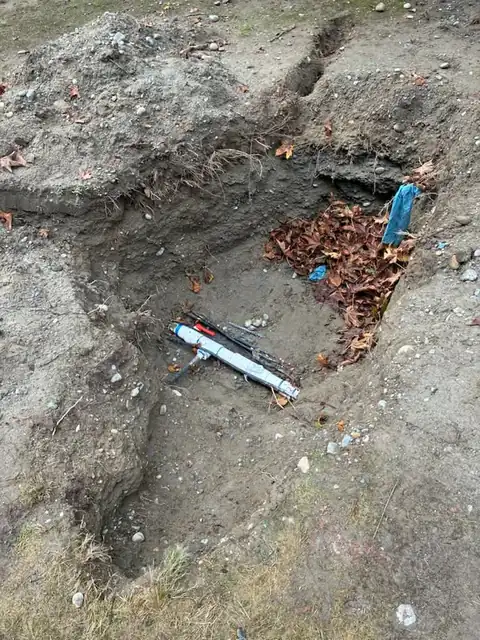
This is most of the uplands: Bremerton's hills, the Silverdale and Port Orchard plateaus, the Kingston and Hansville uplands, Seabeck, Olalla. The first foot or so is workable topsoil; below that the till is dense, gray, studded with cobbles, and nearly impermeable. Water from a leaking pipe can't go down, so it goes sideways along the top of the hardpan or along the backfilled pipe trench, which is looser than the undisturbed ground around it. It surfaces wherever that path meets a low spot, a slope or a cut. Fifty to a hundred feet from the break is routine. Hardpan is slow digging by hand and reasonable with a mini excavator, and trench walls stand well.
Outwash
The Clear Creek valley and the Dyes Inlet flats around Silverdale, the Liberty Bay lowland around Poulsbo, the Kingston townsite, much of Port Townsend and the Quimper Peninsula. Sand and gravel, sorted by meltwater, draining freely. A leak here goes straight down and away. There may be no wet spot at all for a year; the first sign is a bill or a pressure drop. Outwash digs fast but the walls slough, and in winter the water table is close enough that pits fill.
Kitsap Formation clay
Bainbridge Island is the famous case, but the clay is also on the Port Orchard hillsides, the Manchester, Enetai and Tracyton bluffs, the Indianola and Suquamish shorelines, and slopes across the county. It holds water through the wet season, swells and shrinks with the seasons, and moves rigid pipe at every joint. A leak in clay stays hidden for months and then shows up as a sagging driveway or a wet crawlspace. Clay sticks to the bucket, makes a trench heavy and slick, and on a bluff lot turns a leak into a slope stability concern.
Peat and wet bottoms
Big Beef Creek and Stavis Creek valleys in Seabeck, the Olalla Creek valley, Clear Creek's wetlands, and a hundred smaller bottoms. Saturated, soft, and full of organic material. Leaks are invisible against the general wetness; trench walls don't stand; pipe needs proper bedding so it doesn't sit in muck.
Beach deposits
Point No Point, Twin Spits and Driftwood Key in Hansville; the beach shelves at Indianola, Manchester, Keyport and Manitou Beach. Sand and gravel at the water table. Leaks don't surface, pits fill as they're dug, and lines are often shallow because the original cabins were seasonal.
What this means for finding a leak
In every one of these soils, where the water comes out tells you almost nothing about where the pipe failed, and in some of them nothing comes out at all. Acoustic leak detection doesn't care: the sound of pressurized water escaping the pipe travels along the pipe and up through the ground to the surface, and a ground microphone and correlator find the break itself. Knowing the local soil tells the technician what to expect from the sound and how the dig will go.
Written by the crew at 360 Leak Finders
We locate, excavate and repair buried water lines and exterior drains across Kitsap County, 24 hours a day. If this guide raised a question about your property, call (206) 354-9906.