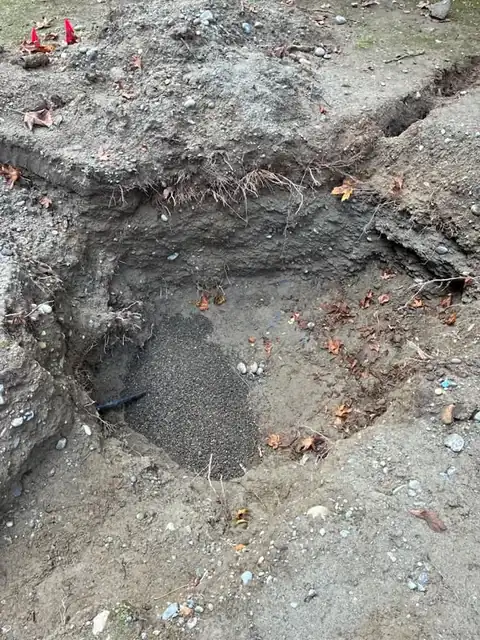
Key takeaways
- In clay and till a French drain can't rely on the soil to absorb water; it must carry water to a gravity outlet.
- A drain without filter fabric fills with silt. A drain without a true grade holds water instead of moving it.
- Curtain drains uphill of a house intercept perched groundwater before it reaches the foundation.
- Dry wells only work in soil that drains, which rules out most of the peninsula's uplands.
What a French drain is
A trench, lined with filter fabric, with a perforated pipe laid on clean rock and surrounded by more clean rock, sloped to an outlet. Subsurface water enters the rock, finds the pipe, and flows away. It is one of the oldest and most reliable drainage tools there is, and one of the most commonly built wrong.
Rule one: outlet first
A drain moves water from where it is to where it can go. In outwash sand the surrounding soil may absorb the water, but on Kitsap's till and clay it won't; the trench just becomes a long narrow pond. Before anything else, find the outlet: a daylight point downhill where the pipe can discharge to open ground, a storm system connection where one exists, or as a last resort a sump and pump. If there's no outlet, there's no drain.
Rule two: true grade
The pipe has to fall continuously toward the outlet. A trench dug by eye across a lumpy yard will have bellies where water sits and silt settles. We shoot grade and dig the trench bottom to it, and the mini excavator makes that straightforward.
Rule three: fabric and clean rock
Filter fabric lining the trench keeps fine soil out of the rock and the pipe. Washed drain rock, not crushed gravel with fines and not native soil, gives water a clear path. Pipe sits on rock, is covered with rock, and the fabric is wrapped over the top before soil goes on. Skip the fabric and the drain silts shut in a few years; we've dug up plenty.
Rule four: placement
A drain intercepts water moving toward it. To protect a house on a slope, the drain goes uphill of the house across the slope, a curtain drain, so perched groundwater is cut off before it reaches the backfill. To dry a soggy lawn, the drain runs through the wet area toward the outlet. To collect surface water, catch basins at the low points feed the drain. Placement follows the water, and reading the water on a lot is the part that takes experience.
Kitsap specifics
On the till plateaus and clay bluffs, assume no infiltration and design for the outlet. In the outwash lowlands around Silverdale, Poulsbo and Kingston, a dry well can work but the winter water table is often too high for it. On beach lots at Hansville, Manchester and Indianola the outlet is usually the beach side and the drain is shallow. On Bainbridge, the clay means curtain drains above the house and gravity outlets, every time.
Written by the crew at 360 Leak Finders
We locate, excavate and repair buried water lines and exterior drains across Kitsap County, 24 hours a day. If this guide raised a question about your property, call (206) 354-9906.