Key takeaways
- A footing drain collects groundwater at the base of the foundation and carries it by gravity to an outlet.
- Corrugated pipe laid in native soil without fabric or clean rock silts shut in a few decades; that describes most 1960s–90s Kitsap installs.
- A footing drain with no working outlet is just a trench full of water next to the foundation.
- Replacement means excavating to the footing, new perforated pipe in fabric on drain rock, and a rebuilt outlet.
What it does
When a foundation is built, the hole around it is backfilled with loose soil that water moves through easily. Groundwater and rain that reaches that backfill flows down to the base of the foundation and, with nowhere else to go, through any crack or joint into the crawlspace or basement. A footing drain is a perforated pipe laid at the base of the footing, surrounded by clean rock, that collects that water and carries it away by gravity to an outlet lower on the lot, a sump, or a storm connection. Done right, it keeps the base of the foundation dry year round.
Why they fail
Three reasons, usually together. First, the pipe: thin corrugated plastic crushes under backfill and traffic and separates at joints. Second, the installation: pipe laid directly in native soil without filter fabric or clean rock fills with silt as fine soil washes into it through the perforations; in Kitsap's silty till that takes a couple of decades. Third, the outlet: the daylight pipe that was supposed to discharge downhill gets buried under landscaping, crushed by a vehicle or clogged with roots, and the drain backs up. We regularly find footing drains that are intact but have had no working outlet for twenty years.
Diagnosing
Find the outlet first. In a hard rain it should be flowing; if it isn't, either the drain is blocked or there's no outlet. Check the crawlspace for where the water enters, which tells you which walls are affected. Where the footing drain can be reached at a cleanout or the outlet, flow testing and probing narrow the failure. Often a test pit at the uphill corner confirms crushed or silted pipe.
Replacement
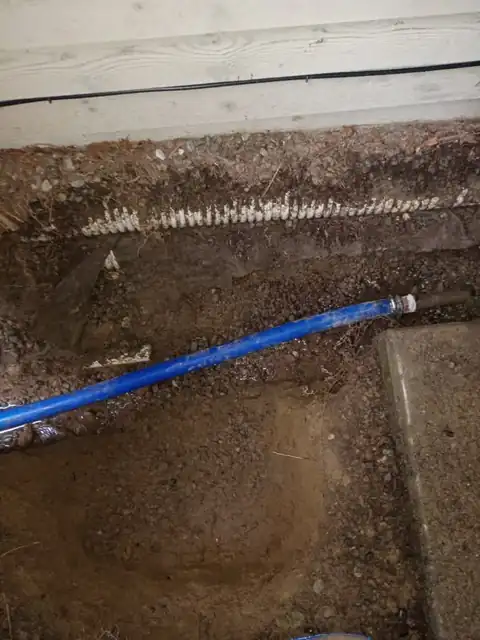
The affected walls are excavated to the footing with the mini excavator and hand tools, with shoring and spoils managed on a tight site. The old drain comes out. New perforated PVC or HDPE goes in on a bed of clean drain rock, wrapped in filter fabric, sloped to the outlet. The outlet is rebuilt as a daylight pipe, a sump, or a storm tie-in. The trench is backfilled with drain rock and fabric, not native clay, so water reaches the pipe for decades. The foundation wall can be waterproofed while it's exposed. Grading is restored sloping away from the house.
Downspouts stay separate
Roof water should never be tied into a footing drain. A roof sheds far more water than the drain is sized for and will overwhelm it in every storm. Downspout lines run separately to their own outlet.
Written by the crew at 360 Leak Finders
We locate, excavate and repair buried water lines and exterior drains across Kitsap County, 24 hours a day. If this guide raised a question about your property, call (206) 354-9906.