Key takeaways
- On a slope, water from a leak surfaces well downhill of the break, often at a retaining wall, a bulkhead or a neighbor's yard.
- Natural seeps from perched groundwater are common on Kitsap bluffs and look exactly like leaks; the meter test and acoustic detection tell them apart.
- A service line that runs up or down a slope from a road-side meter is the usual layout, and the break can be anywhere along it.
- Curtain drains across the slope above the house are the standard fix for a chronically wet crawlspace on a hillside lot.
Why slopes are different
A large share of Kitsap's waterfront and view housing sits on bluffs and hillsides: Port Orchard above Sinclair Inlet, Tracyton and Enetai above Dyes Inlet and Port Orchard Bay, Manchester above Rich Passage, Suquamish and Indianola above Agate Pass and Port Madison, and most of Bainbridge Island's shoreline. These slopes are glacial till and Kitsap Formation clay, which hold water, move with the seasons, and carry anything that leaks downhill. The meter is at the road, the house is down the slope, and the service line connects the two.
Seep or leak?
Water appearing at the base of a slope in winter is often just the bluff draining: rain that fell uphill, perched on the hardpan, and worked its way out. It isn't under pressure, it doesn't make leak noise, and the meter doesn't move with the house isolated. A leak on a pressurized service line does all three. The confusing cases are the ones where a real leak feeds a seep that was already there; the meter test is what sorts those out, and it takes five minutes.
Locating on a slope
We trace the line down the slope from the meter, listen along it with the ground microphone, and on long runs put correlator sensors at the meter and the house shutoff. The break is marked where it is, which on a slope is routinely fifty feet or more uphill of where the water came out. Then one excavation happens there, not at the bulkhead.
Excavating without making an erosion problem
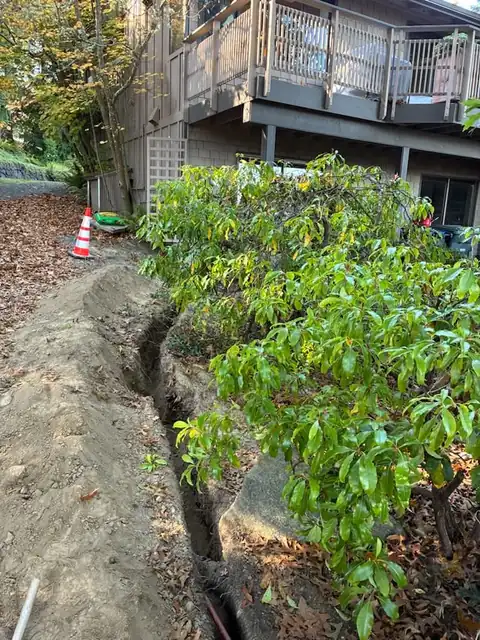
An open trench on a slope above the water is a liability if it's handled carelessly. We keep spoils on tarps rather than loose on the slope, keep the excavation as small as the pinpointed break allows, pump groundwater away from the cut, backfill in compacted lifts the same day where possible, and restore the surface with the grade and vegetation it had. Where a line has failed before on a slope, a continuous HDPE replacement pulled through the old route from a pit at each end keeps the disturbance to the two ends.
Drainage on a slope lot
A hillside house gets water from above all winter. The standard fix is a curtain drain, a French drain across the slope uphill of the house that intercepts perched groundwater and carries it around to a daylight outlet downhill, combined with a working footing drain and downspout lines that discharge below the house rather than into the bank. Dry wells don't work in this ground; everything needs a gravity outlet, which on a slope is at least easy to find.
Written by the crew at 360 Leak Finders
We locate, excavate and repair buried water lines and exterior drains across Kitsap County, 24 hours a day. If this guide raised a question about your property, call (206) 354-9906.