Key takeaways
- Spot repair is right for a single failure on sound pipe of a durable material.
- Replacement is right for polybutylene, old galvanized, brittle poly, and any line that has failed more than once.
- On long runs the cost of a third and fourth repair usually exceeds one continuous new line.
- The decision should be made with the pipe exposed, not from the driveway.
The question nobody can answer from the surface
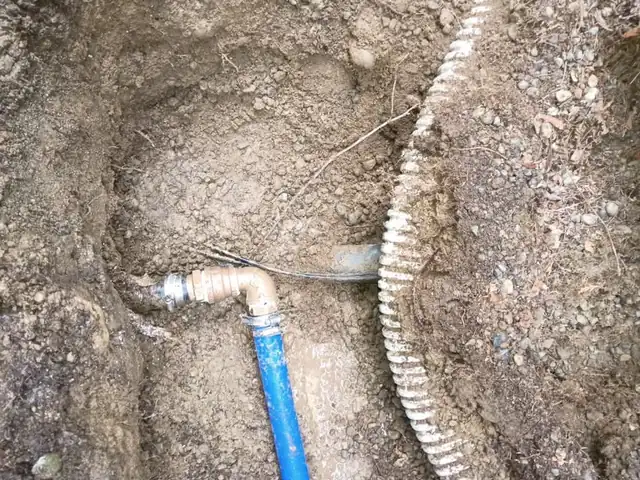
A locate finds the break. It does not tell you the condition of the rest of the pipe. That is why the repair-or-replace decision happens with the ground open and the pipe in front of you, and why a contractor who both locates and excavates can give you a better answer than one who only does one.
When a spot repair is the smart money
- The pipe is a durable material in good condition: modern HDPE, PEX, or copper that is sound on both sides of the break.
- The failure has an obvious external cause: a fence post, a stake, a root, a rock pressing on the pipe, an earlier excavation.
- The failure is at a single fitting and the pipe itself is fine.
- This is the first failure on the line.
- The run is short and the pipe could be replaced later without much more disruption than today's repair.
When replacement is the smart money
- The pipe is polybutylene. It degrades from the inside everywhere at once.
- The pipe is galvanized steel that has rusted through. Every other joint is the same age.
- The pipe is thin-wall 1970s or 80s polyethylene that has gone brittle and cracks when handled.
- The line has failed before. Two failures means the third is coming.
- Copper that shows pitting or multiple pinholes along its exposed length.
- The run is long and expensive to locate on, and repeated repairs are adding up.
- A remodel, addition or driveway project is exposing the line anyway.
How replacement is done
A replacement line is continuous HDPE or PEX from the meter to the house with no buried joints. Where the old line is intact enough, the new pipe is pulled through its route from a pit at each end, which leaves the driveway and most of the yard untouched. Otherwise a trench is opened along the new route with a mini excavator. The pipe is bedded in clean gravel, connected with buried-rated fittings, pressure tested, and backfilled in compacted lifts with tracer wire. Most residential replacements are one to two days including restoration.
The emergency compromise
Sometimes the right sequence is both: a sound spot repair tonight to get the water back on, and a replacement scheduled for when it suits you. There's nothing wrong with that as long as everyone understands the repair is a bridge, not the destination.
Written by the crew at 360 Leak Finders
We locate, excavate and repair buried water lines and exterior drains across Kitsap County, 24 hours a day. If this guide raised a question about your property, call (206) 354-9906.