Key takeaways
- Flexible pipe laid in one continuous piece with no buried joints is the right choice in ground that moves, which describes most of Kitsap.
- HDPE and PEX-A are both excellent for buried service; HDPE for long runs and pulls, PEX for shorter runs and easy transitions.
- Copper is a fine material undermined by joints, aggressive soil and the cost of installing it in long runs.
- Bedding, depth, fittings and tracer wire matter as much as the pipe.
The problem buried pipe has to solve
Kitsap County's ground moves. Clay-rich soils on Bainbridge Island, the Port Orchard hillsides and the shoreline bluffs swell when wet and shrink when dry. Till settles unevenly over backfilled trenches. Tree roots push. Freeze-thaw cycles, while milder here than east of the mountains, still happen in the shallow zone. Every one of those forces concentrates at a joint, and every joint in a buried line is a future leak. The best buried water line has as few joints as possible, ideally none between the meter and the house.
HDPE
High-density polyethylene is a black, flexible pipe that comes in long coils and can be laid or pulled in a single continuous run of hundreds of feet. It is resistant to corrosion, tolerates ground movement by flexing, and is joined at the ends with buried-rated compression or fusion fittings. For long runs on acreage in Kingston, Seabeck, Lofall and Olalla, for driveway pulls on Bainbridge, and for replacing failed lines by pulling through the old route, HDPE is our default. SDR 9 or SDR 11 wall thickness depending on pressure and size.
PEX
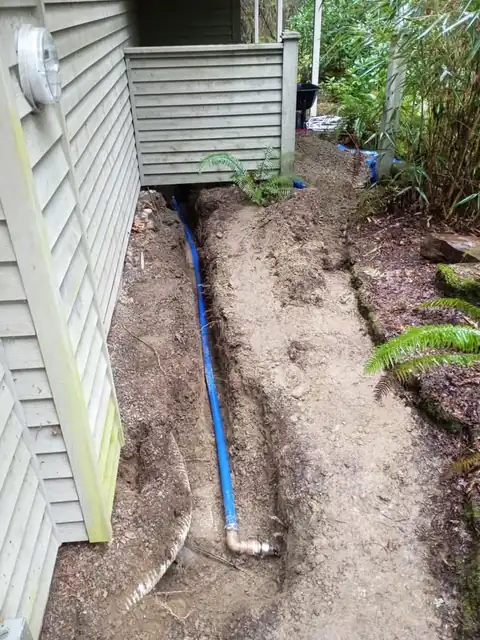
Cross-linked polyethylene, typically blue for cold water, is also flexible and comes in long coils. PEX-A, the most flexible type, is well suited to buried service lines, is easy to transition to copper or galvanized at the house, and is what we use for most shorter residential repairs and replacements. It should be rated for direct burial, bedded in clean material, and kept out of sunlight before installation.
Copper
Type K copper is a time-tested service line material and still used by some utilities. Its weaknesses underground are joints, which are soldered or compression and fail with movement; aggressive or acidic soils, which pit it; and cost, which makes long runs expensive. The copper lines we dig up on 1960s and 70s Kitsap homes have usually pinholed from the outside in or failed at a fitting. We'll repair copper, but for replacement we recommend flexible pipe.
What matters besides the pipe
- Bedding: pipe should sit on and be surrounded by clean gravel or sand, not native clay, cobbles or muck.
- Depth: below the frost line and deep enough to be protected from surface loads; your utility may specify a minimum.
- Fittings: brass or stainless, rated for burial. Interior-grade fittings corrode underground.
- Tracer wire: a wire buried alongside plastic pipe so the line can be located in the future. Required by many utilities and simply smart.
- Sleeves: under driveways and patios so the line can be serviced without breaking concrete.
- Pressure test: before backfill, every time.
Written by the crew at 360 Leak Finders
We locate, excavate and repair buried water lines and exterior drains across Kitsap County, 24 hours a day. If this guide raised a question about your property, call (206) 354-9906.