Key takeaways
- Galvanized steel was the standard service line material before the 1960s and is common under Bremerton's wartime housing.
- It corrodes from the inside, narrowing the bore (low pressure) and eventually rusting through, usually at a threaded joint.
- A galvanized line that has failed in one place is failing everywhere; replacement is almost always the right call.
- Transitioning galvanized to PEX or HDPE requires the right dielectric and buried-rated fittings.
A wartime legacy
Bremerton's population roughly quadrupled during the Second World War as Puget Sound Naval Shipyard ramped up, and the housing built to absorb that growth in Charleston, Manette, Sheridan Park and the surrounding grids was plumbed with galvanized steel, the standard of the day. Keyport grew the same way around the torpedo station. Poulsbo's and Port Townsend's historic cores are older still. A surprising number of those homes have never had the buried service line replaced.
How galvanized fails
Galvanized pipe is steel with a zinc coating. Over decades the zinc is consumed, and the steel underneath rusts. Rust builds up inside the pipe, narrowing it, which is why old galvanized homes have low pressure and rusty water after a shutoff. Eventually the wall rusts through, almost always at a threaded joint where the wall was cut thinnest, or where the pipe passes through a foundation wall and sits in damp concrete. Leaks start small and grow.
Recognizing it
At the point of entry, galvanized pipe is gray or rust-brown metal with threaded fittings, often with a bulge of rust at the joints, and a magnet sticks to it. Copper is reddish and non-magnetic. If the house predates 1960 and the line is threaded steel, it's galvanized.
Why we recommend replacement
A galvanized line that has rusted through at one joint has rusted the same amount at every other joint. A spot repair buys months. Replacement from the meter to the house in continuous PEX or HDPE, with no buried joints, restores pressure and ends the problem. On Bremerton's short city lots that's often a single-day job, and it's frequently done at the same time as a footing drain or downspout line repair in the same trench along the foundation.
Transition fittings
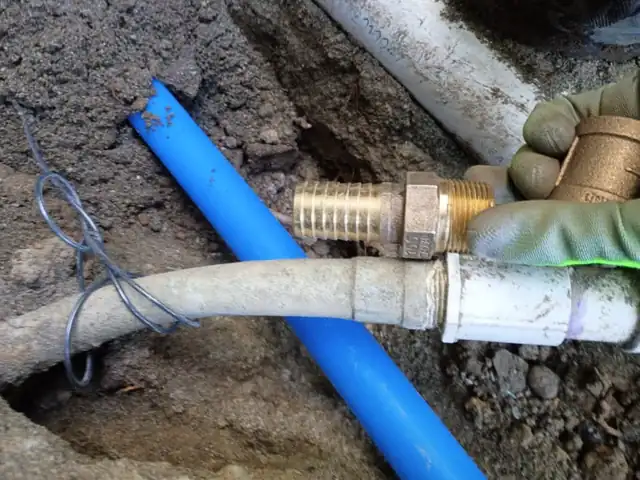
Connecting new plastic pipe to remaining galvanized at the house or the meter needs the right fitting: a dielectric transition where metals meet, and buried-rated brass or stainless compression fittings on the plastic side. A galvanized stub inside the house is usually replaced back to the first good fitting.
Written by the crew at 360 Leak Finders
We locate, excavate and repair buried water lines and exterior drains across Kitsap County, 24 hours a day. If this guide raised a question about your property, call (206) 354-9906.