Key takeaways
- Confirm, trace, listen, correlate, mark, then dig: the order is the method.
- One crew locating, excavating, repairing and restoring means no handoffs, no waiting on a second contractor, and one accountable company.
- The repair-or-replace decision is made with the pipe exposed, not from the driveway.
- Restoration is part of the job, not an extra.
The phone call
We ask what you're seeing, whether you're on a utility or a well, whether the water is off, and whether it's an emergency. For an emergency we dispatch immediately with everything on the trailer. For a scheduled investigation we give you a window and ask you to make sure the meter, the house shutoff and the suspect area are accessible.
Confirm
Meter test or pressure tank test. Every fixture closed, low-flow indicator watched, house isolated, flow timed. We leave this step with a number for how much water is leaving and a clear answer on whether the loss is on the buried line.
Trace
The line's actual route from the meter or well to the point of entry, with a pipe locator on metallic pipe and tracer wire and acoustic and sonde methods on plastic. Marked on the ground.
Listen and correlate
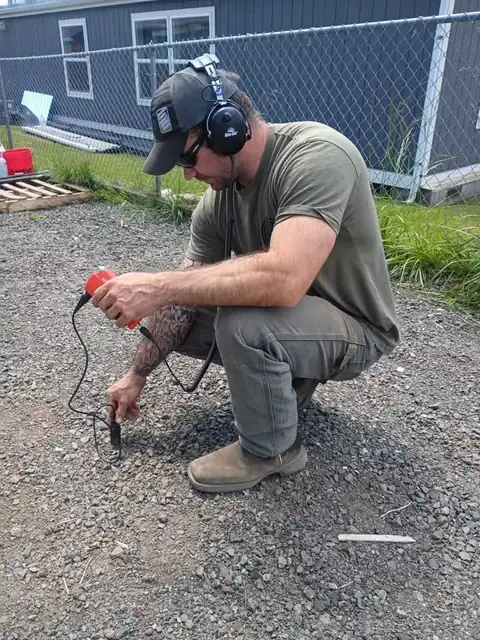
Ground microphone along the traced route. Correlator across long runs. The break is narrowed, then pinpointed, then confirmed with a probe where the ground allows. Paint and flags, with a depth estimate.
Dig once
Utility locates called for machine work. Tarps and plywood down. Hand tools for shallow, tight spots; the mini excavator for depth, hardpan and long runs. Pumps if the pit fills. One excavation, at the break.
Decide with the pipe in hand
The failed section exposed, the pipe on either side assessed. Sound pipe with a single failure gets a spot repair. Polybutylene, old galvanized, brittle poly or a repeat failure gets a straight recommendation to replace, with the evidence in your hand. Emergency tonight, replacement later, is a fine answer when that's what the situation needs.
Repair, test, restore
Buried-rated fittings on PEX or HDPE. Pressure test before backfill. Gravel bedding, compacted lifts, tracer wire. Surface restored: lawn, gravel, bark, pavers. Water on. Site clean. A written description of what was found and done.
Why in-house matters
A locate-only company marks the spot and leaves. A plumber without an excavator waits on a sub. A general excavator without locating equipment digs on a guess. Doing all of it with one crew means the locate is done knowing the dig is ours, the dig is done knowing the repair is ours, and the restoration is done because we'll be the ones you call next time.
Written by the crew at 360 Leak Finders
We locate, excavate and repair buried water lines and exterior drains across Kitsap County, 24 hours a day. If this guide raised a question about your property, call (206) 354-9906.