Key takeaways
- Clay tile separates at joints and admits roots; thin corrugated plastic crushes and silts; both are common under pre-1990s homes.
- A failed drain is diagnosed by tracing, outlet flow testing, probing and a test pit; no pressure means no acoustic method.
- Replacement uses solid or perforated PVC or HDPE on gravel at a true grade with cleanouts and a rebuilt outlet.
- Exterior drain work in Washington is excavation and drainage work, not plumbing.
The materials under older homes
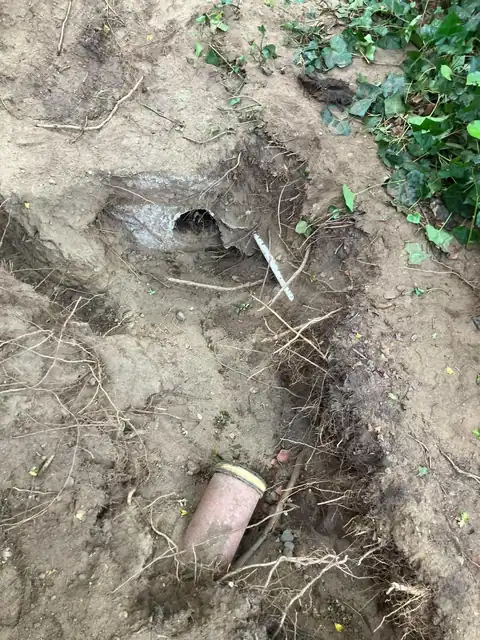
Before the 1970s, exterior drains were often clay tile: short sections of fired clay pipe laid end to end with no sealed joints. Roots enter at every joint, the sections shift and separate, and a shovel or a vehicle breaks them. From the 1970s on, thin corrugated black plastic became the norm for footing drains, yard drains and downspout lines. It's cheap, easy to lay, and after a few decades it's crushed, flattened, separated at the fittings, or silted solid because it was laid in native soil without fabric. Solid PVC and HDPE, laid properly, are what replace both.
How a failed drain shows itself
Water backing up at a downspout or yard drain in rain. A catch basin that fills and never empties. A sinking line in the lawn over a collapsed pipe. Roots visible at an outlet. A crawlspace wet after every storm. Water surfacing partway along a drain's route where it has separated. Or old clay or crushed corrugated pipe found during other digging, which is how a lot of failures get discovered.
Diagnosing without pressure
Drains aren't pressurized, so acoustic leak detection doesn't apply. Diagnosis is tracing the route, running water in at the top and watching the outlet, probing along the route for soft or wet zones, and opening a test pit at the suspect spot. On a footing drain the cleanouts and the outlet are the access points. It's detective work, and the test pit usually tells the story.
Replacement
The failed run is excavated, the old pipe removed, and new pipe laid on a gravel bed at a continuous grade to the outlet: solid pipe for downspouts and conveyance, perforated pipe in fabric and rock for collection. Cleanouts go in at direction changes and long runs. The outlet is rebuilt so it actually discharges. Backfill in lifts, surface restored. Exterior drain work in Washington is excavation and drainage work and doesn't require a plumbing license; it's a core part of what we do.
Written by the crew at 360 Leak Finders
We locate, excavate and repair buried water lines and exterior drains across Kitsap County, 24 hours a day. If this guide raised a question about your property, call (206) 354-9906.